
iRobot Roomba Max 875 Combo Review: Hot-Water Mopping and the $1,199.99 Question
iRobot Roomba Max 875 Combo review: Editor’s Disclosure
This review is based on iRobot’s product information and the Roomba Max 875 Combo owner’s guide. I have not personally tested the robot. Its cleaning performance, navigation, noise levels, and long-term reliability have not been independently verified for this review.
The iRobot Roomba Max 875 Combo is built around a simple idea: let one robot vacuum your floors, mop hard surfaces, and return to a dock that handles much of the cleanup afterward.
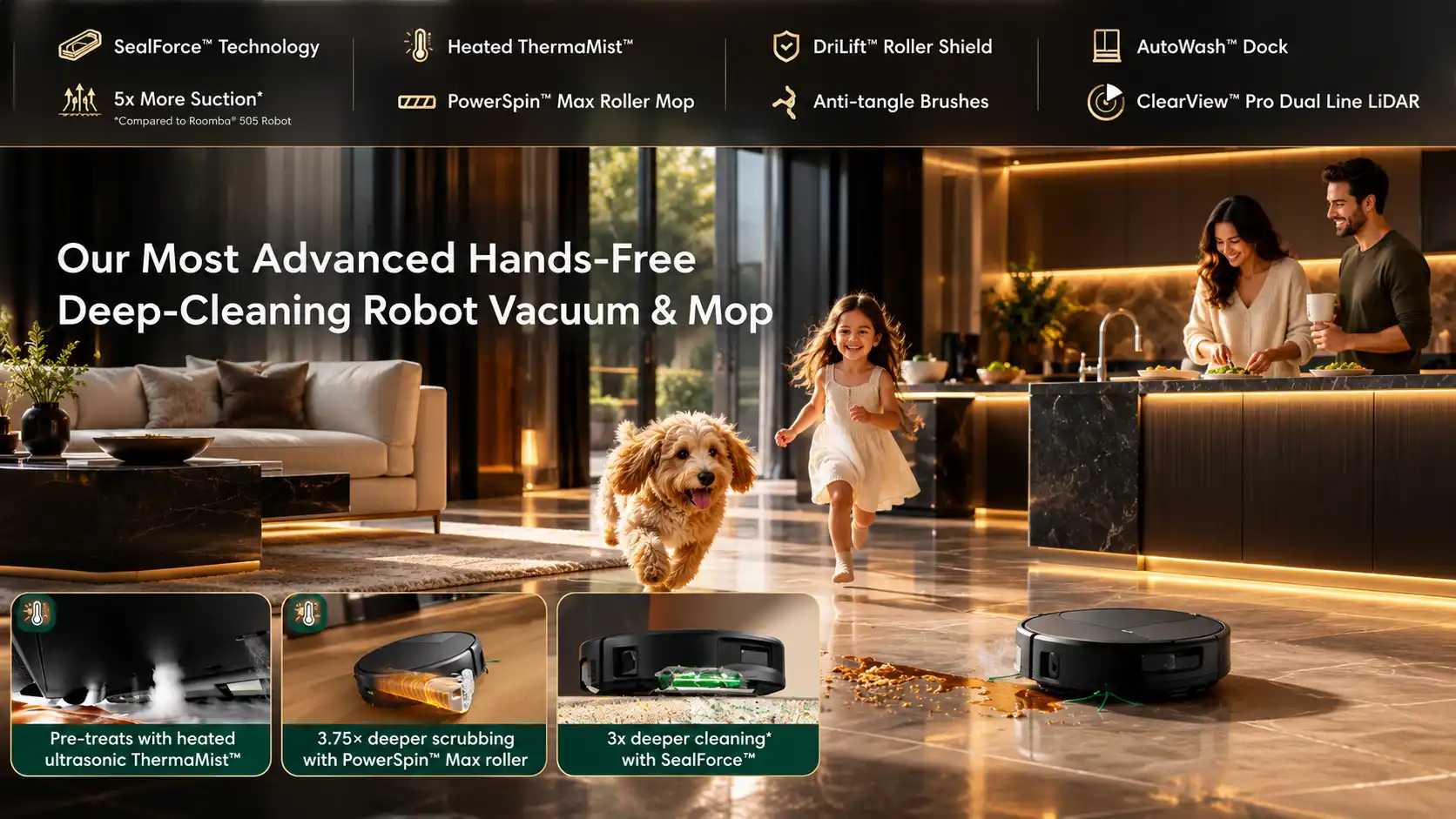
Its PowerSpin Max Roller Mop uses heated-water cleaning, while the AutoWash Dock washes and dries the roller and empties collected debris. The robot also features LiDAR mapping, AI-based obstacle recognition, and a system designed to protect carpets during mopping.
On paper, that is a lot of work for one machine. The question is whether the combination makes everyday cleaning easier enough to justify its listed price of $1,199.99.
At this price, buyers need more than an impressive feature list. How well does the robot collect pet hair? Can its roller mop tackle dried spills? And does the dock save enough time to justify its own maintenance? These are the questions that matter in everyday use.
I haven’t tested the Max 875 in a home, so I can’t give you first-hand answers. What I can do is examine its advertised features, the owner’s guide, the maintenance requirements, and the details worth checking before you buy.
Quick Verdict
The Roomba Max 875 Combo is designed for households that want vacuuming and active mopping in one machine, with less hands-on work between cleaning sessions.
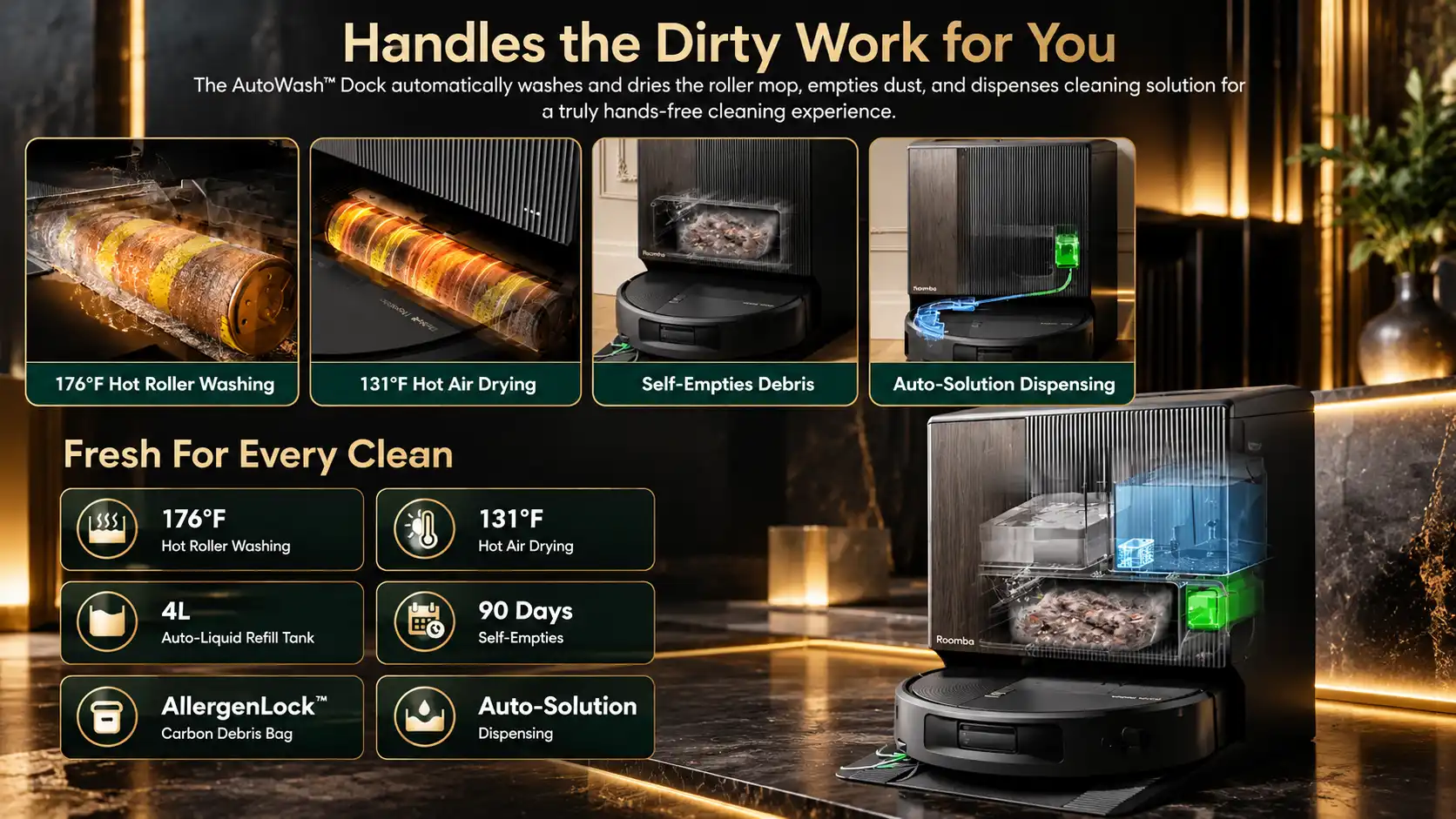
Its main attractions are the PowerSpin Max Roller Mop, 140°F ThermaMist spray, DriLift carpet-protection system, and AutoWash Dock. The dock empties collected debris, washes the roller with hot water, and dries it with heated air. These features could make routine floor care easier to manage.
There is still work for the owner. The clean-water tank needs refilling, the dirty-water tank needs emptying and cleaning, and the dock’s tray, brushes, filter, and mop roller require regular attention. Setup also requires the Roomba Home app and a 2.4 GHz Wi-Fi connection.
The bigger question is cleaning performance. The product materials describe improved suction and stain removal, but neither claim has been independently tested for this review. Specifications explain what the robot is designed to do; they cannot establish how well it will handle everyday messes in a real home.
The short verdict: The Max 875 has an appealing combination of vacuuming, roller mopping, and dock automation. At $1,199.99, I would want independent cleaning results and a clear picture of ongoing costs before recommending it without reservation.
Key Features of the Roomba Max 875 Combo
Vacuuming: SealForce Technology and Brush Design
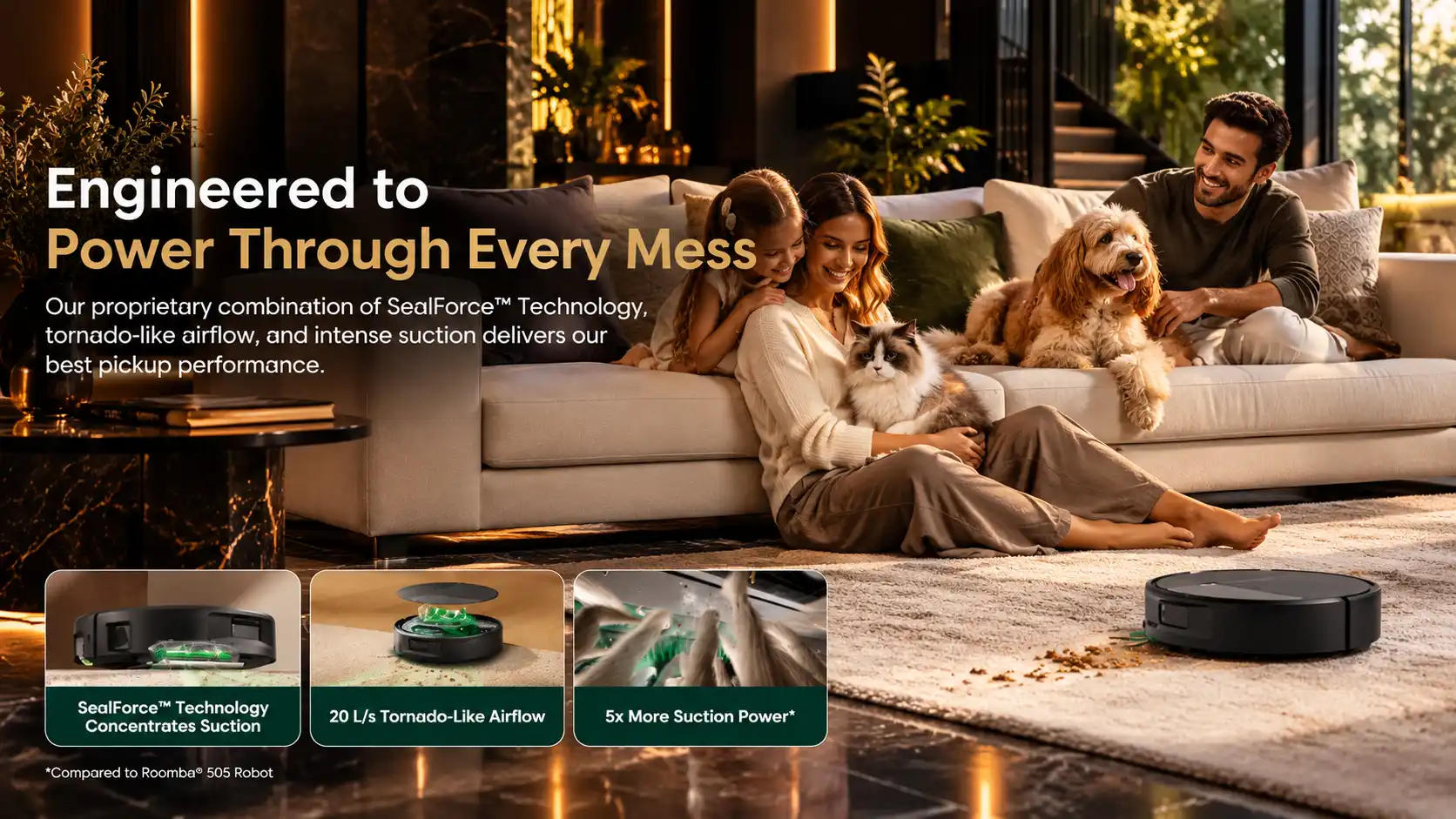
The Max 875 combines SealForce Technology with a multi-surface brush system designed to collect dust, crumbs, and pet hair. iRobot claims five times more suction than the Roomba Plus 505 Combo. This is a manufacturer comparison, not an independently verified result in this review.
The brush system includes a multi-surface main brush with a hair-cutting design and an anti-tangle side brush. Both are intended to help collect hair while reducing the amount that wraps around the brushes.
That could be useful in a home with pets or people with long hair. Still, the design alone cannot tell us how much hair the robot picks up from a thick carpet, whether it leaves fine dust behind, or how often the brushes need attention.
Those are practical questions, and they matter more than the name of the technology. Without hands-on testing, the Max 875’s actual pickup performance remains unconfirmed.
ThermaMist: Heated Spray for Stubborn Messes
The Max 875 uses ThermaMist to apply a heated mist at a stated temperature of 140°F. The system is designed to soften dried-on messes before the roller mop passes over them.
This is intended to help with everyday marks from food spills and similar messes. The product materials claim twice the stain removal compared with mopping without ThermaMist, although the test conditions behind that comparison have not been established here.
That comparison needs context. The supplied material does not establish the test conditions or provide independent results, so the claim should not be read as a promise that the robot will remove twice as many stains in every home.
A dried coffee spill, a fresh splash of water, and greasy residue are different cleaning jobs. Results can also depend on the floor surface and how long a stain has been there. Independent testing would help establish where the heated spray makes a meaningful difference.
Floor compatibility matters, too. The owner’s guide warns against using the mopping function on unsealed hardwood and certain laminate or vinyl flooring because moisture can damage the floor or its subfloor. Check both iRobot’s instructions and your flooring manufacturer’s guidance before using wet cleaning.
PowerSpin Max Roller Mop
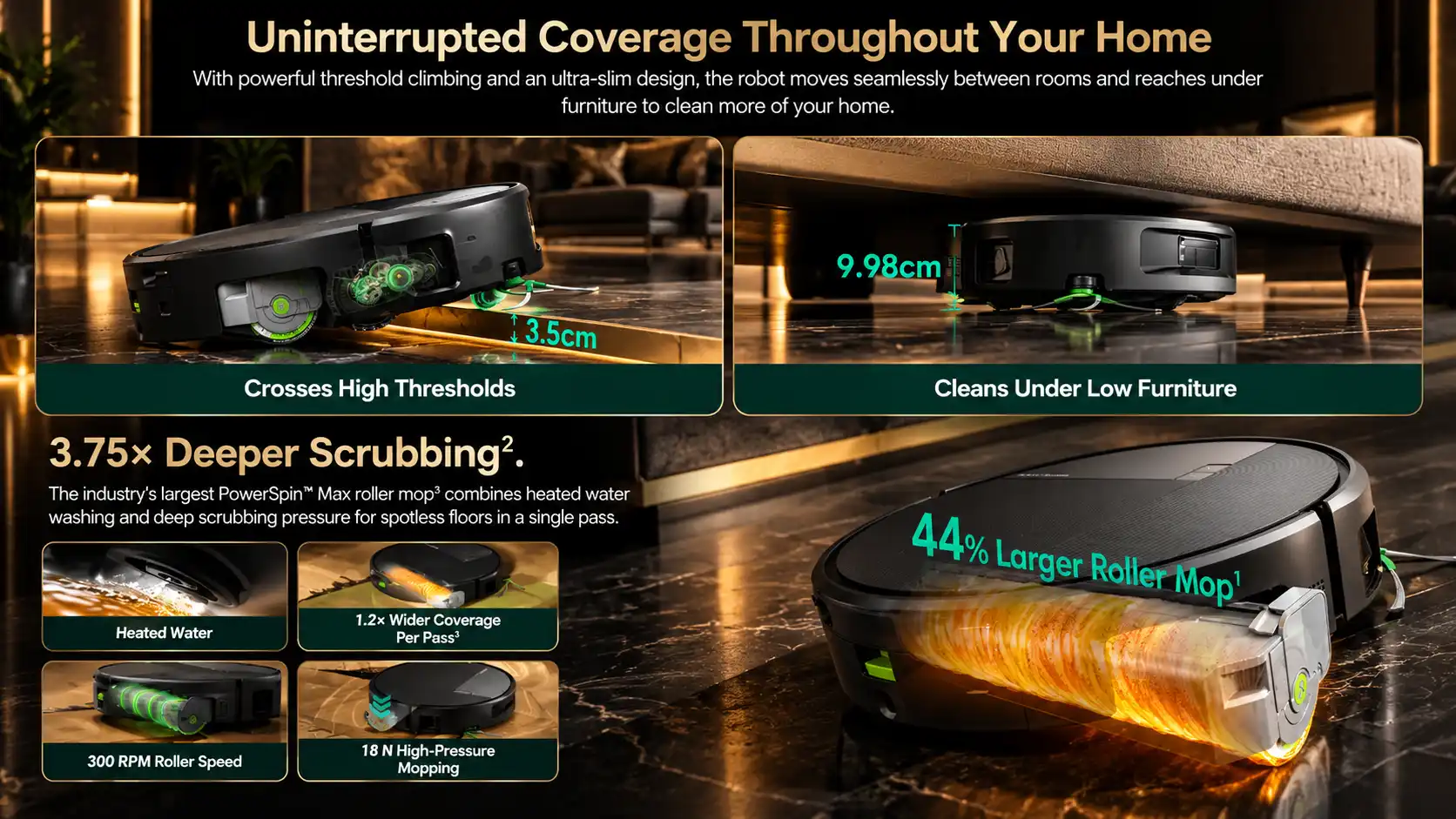
Instead of relying on a conventional flat, damp pad, the Max 875 uses a powered roller mop designed to scrub hard floors. The listed roller speed is 300 RPM, and the system is designed to apply downward pressure during cleaning.
This is accurate and appropriately cautious. It tells readers exactly why you aren’t choosing one number over the other. No replacement is needed.
The roller returns to the dock for washing after a cleaning routine. That gives the system a way to clean the mop between sessions rather than leaving the owner to wash the pad after every run.
Whether this arrangement removes dried spills more effectively than a competing robot mop is a separate question. Roller speed and pressure figures describe parts of the design, but they don’t tell us how much residue remains on the floor.
For a buyer spending more than $1,000, a direct comparison of cleaning results would be far more useful than another specification alone.
PerfectEdge: Reaching Along Walls
The PerfectEdge system is designed to extend the mop roller up to 45 mm along walls and baseboards. An expanding side brush also helps the robot reach toward corners and furniture.
The idea is to leave less dirt behind along the edges of a room, where a robot’s main cleaning path may not reach.
The stated reach is a design specification, not proof of complete edge cleaning. Room layout, furniture, and the kind of debris on the floor can all affect the result. Independent testing would be needed to establish how consistently the system cleans along baseboards and around corners.
DriLift: Protecting Carpets During Mopping
The Max 875 includes DriLift technology, which is designed to detect carpet, raise the mop, and lower a protective shield around the roller.
This feature matters because a combined vacuum-and-mop robot may move between hard floors and rugs during the same cleaning routine. Automatic mop protection could reduce the need to prepare each room manually.
There is a difference, however, between a system designed to protect carpets and a guarantee that every rug will remain dry. Carpet thickness, construction, placement, and the robot’s ability to recognize a surface may affect what happens in practice.
If you have valuable rugs or carpets that cannot tolerate moisture, check the available settings and manufacturer’s guidance before relying on automatic protection.
AutoWash Dock: Less Cleanup, Not No Cleanup
The AutoWash Dock handles several tasks after a cleaning session:
- Empties collected debris into a disposable dust bag.
- Washes the roller mop with water heated to 176°F.
- Dries the roller with 131°F heated air.
- Manages the clean and dirty water used during mopping.
- Dispenses compatible StayClean cleaning solution.
The AutoWash Dock is advertised as providing up to 90 days of hands-free maintenance by automatically emptying debris and washing and drying the roller. This does not mean the entire system can run for three months without attention; the water tanks, dock tray, and other components still need regular care.
The owner’s guide calls for regular maintenance. The dock’s tray should be cleaned every two weeks or as needed. The water tanks need attention, and the dirty-water tank should be cleaned promptly to help prevent odors and mold. The guide also calls for monthly cleaning of the dock’s sensors and charging contacts.
The dock reduces some repetitive tasks, but it adds its own parts to maintain. Buyers should consider whether they are comfortable handling dirty water, cleaning the tray, and replacing consumables.
For some households, that trade-off will be worthwhile. For others, a simpler robot with fewer dock components may be easier to live with.
LiDAR Mapping and Obstacle Recognition
ClearView Pro LiDAR is designed to map rooms and help the robot plan its route. PrecisionVision AI is described as a system that can recognize and avoid more than 300 common objects.
The stated capabilities include mapping in under 10 minutes, storage for up to three maps, and threshold climbing of up to 3.5 cm.
These features are intended to help the robot move through a home, recognize obstacles, and clean different rooms without relying on random movement.
The advertised object count does not mean the robot will avoid every object it encounters. Small items, cables, unusual shapes, and objects the system does not recognize may still cause trouble. Similarly, a stated climbing height does not guarantee that every doorway threshold will be passable.
For a robot that may cost $1,199.99, consistent navigation around real household clutter is worth checking in independent reviews before making a decision.
Daily Use: What Living with It Could Be Like
The Max 875 is designed to make routine floor cleaning easier to schedule. Once setup is complete, owners can use the Roomba Home app to select rooms, choose cleaning modes, and set routines.
It offers four modes:
- Vacuum only: for collecting loose dirt without wet cleaning.
- Mop only: for hard-floor cleaning without a vacuuming cycle.
- Vacuum and mop: for combining both tasks in one routine.
- Vacuum, then mop: for collecting loose debris before washing the floor.
The last mode may suit people who prefer to remove dust and crumbs before wet cleaning. Running both functions together may save time, while separate modes offer more control over different rooms and floor types.
The robot is also designed to return to the dock when it needs charging and resume a cleaning task after charging enough to continue. That could help with larger homes, although the actual area cleaned per charge has not been independently measured for this review.
Setup and Dock Placement
Before buying, check where the dock will go. It needs a hard, level surface rather than carpet, a suitable power outlet, and enough open space for the robot to approach and leave.
The owner’s guide specifies more than 20 cm of clearance on each side, more than one metre in front, and a position at least 1.5 metres from stairs. Keeping that area clear should help the robot return to the dock without obstruction.
Setup uses the Roomba Home app and requires a 2.4 GHz Wi-Fi connection. The guide says 5 GHz networks are not supported for setup. It also recommends charging the robot for four hours before the first cleaning cycle.
None of these requirements is unusual for a connected robot cleaner, but they can affect whether the system fits comfortably into your home. A large dock squeezed into a narrow hallway may be less convenient than the product’s feature list suggests.
What Owners Still Need to Do
The dock takes over several jobs, but it does not eliminate regular upkeep. Owners should expect to:
- Refill the clean-water tank as needed.
- Empty and rinse the dirty-water tank.
- Clean the dock’s tray and water tanks.
- Inspect and clean the brushes and wheels.
- Keep sensors and charging contacts clean.
- Clean and air-dry the roller mop when required.
- Replace the dust bag, cleaning solution, filter, brushes, and roller as needed.
The owner’s guide recommends cleaning the side brush and main brush monthly. Its suggested replacement intervals are three to six months for the side brush and six to twelve months for the main brush. It lists a six-to-twelve-month replacement interval for the filter and recommends replacing the roller mop about every three months for optimal mopping results.
These are recommendations, not guarantees of how long each part will last. Usage, hair, dust, and the condition of your floors can affect maintenance needs.
There is also a cost to keeping the system running. Dust bags, filters, brushes, rollers, and cleaning solution may add up over time. The supplied information does not establish the total annual cost of these supplies, so buyers should check current replacement prices before purchasing.
App Control
The Roomba Home app is required for setup and provides the main way to control the Max 875.
The Roomba Home app lets users choose when, where, and how the robot cleans. It supports schedules, room selection, cleaning modes, and customized preferences. It also provides maintenance reminders and access to support information.
The robot is advertised as compatible with Alexa, Siri, and Google Assistant-enabled devices. That may be useful if you already use one of those assistants to control devices at home.
The practical point is that the app is part of the ownership experience, rather than an optional extra for occasional convenience. If you prefer a floor cleaner that can be set up and used without a connected app, consider whether this system’s approach suits you.
Who Is the Roomba Max 875 Combo For?
Homes with Both Hard Floors and Carpets
The combination of vacuuming, roller mopping, and automatic carpet detection is intended for homes with mixed flooring. The four cleaning modes also give owners different ways to handle rooms that need different kinds of care.
The main uncertainty is how well the carpet-protection system performs in practice. Buyers with delicate or valuable rugs should not assume that automatic detection makes every mixed-floor routine risk-free.
People Who Want Less Hands-On Cleaning
The AutoWash Dock handles several tasks that would otherwise require attention after a cleaning session. It could suit busy households that want to schedule floor care and spend less time emptying the robot or washing its mop manually.
That convenience comes with maintenance of its own. If you are comfortable cleaning tanks and trays and replacing supplies when needed, the dock may be a useful part of the system.
Pet Owners
The hair-cutting main brush and anti-tangle side brush are designed to help manage pet hair. Automatic debris emptying may also reduce how often you need to handle the robot’s dust bin.
But pet owners should still expect to inspect the brushes, especially in homes with heavy shedding. The supplied specifications do not establish how effectively the Max 875 handles large amounts of hair on carpet, so that is a performance point worth checking in independent tests.
Buyers Who Want One Integrated System
The Max 875 brings vacuuming, mopping, mapping, obstacle recognition, and dock-based maintenance into one setup. It may appeal to someone who would rather manage one integrated system than use separate machines for vacuuming and mopping.
The $1,199.99 price makes comparison important. Look at the cleaning performance, dock functions, replacement costs, warranty terms, and maintenance demands of competing models before deciding.
Who Should Think Twice?
The Max 875 may not be the right fit if you want an inexpensive robot, have little room for a dock, or dislike cleaning water tanks and maintenance components.
It also deserves caution in homes with unsealed hardwood or moisture-sensitive flooring. Follow the flooring manufacturer’s instructions and iRobot’s guidance before using the mopping function on those surfaces.
Technical Specifications
| Specification | Details |
| Brand | iRobot |
| Model | Roomba Max 875 Combo |
| Model number | Z185020 |
| Robot dimensions | Approximately 14.0 × 14.2 × 3.9 inches |
| Robot weight | 5.4 kg, approximately 11.9 lb, according to the owner’s guide |
| Battery | Lithium-ion; 4,400 mAh rated capacity and 5,000 mAh nominal capacity, according to the guide |
| Navigation | ClearView Pro LiDAR |
| Obstacle recognition | PrecisionVision AI; recognition of more than 300 common objects is a manufacturer-stated capability |
| Mopping system | PowerSpin Max Roller Mop with ThermaMist heated spray |
| Advertised ThermaMist temperature | 140°F |
| Advertised roller speed | 300 RPM |
| Advertised edge reach | Up to 45 mm |
| Advertised threshold climbing | Up to 3.5 cm |
| Dock roller-wash temperature | 176°F |
| Dock drying | 131°F heated air |
| Cleaning modes | Vacuum only, mop only, vacuum and mop, vacuum then mop |
| App | Roomba Home |
| Voice assistant compatibility | Alexa, Siri, and Google Assistant-enabled devices |
| Wi-Fi setup | 2.4 GHz network required |
| Listed price | $1,199.99; check the current price before buying |
| Manufacturer warranty | One year, according to the supplied product listing |
Specification notes: Specification notes: The supplied product title lists 40,000 Pa suction, but the available iRobot product information does not consistently confirm that figure. The product announcement lists 35,000 Pa instead, so verify the specification with iRobot before publishing a suction figure. The supplied product information also conflicts on roller pressure, giving 18 N in one place and 20 N in another. Neither pressure figure is treated as confirmed here.
The supplied listing reports a runtime of 210 minutes, but iRobot’s support documentation lists 180 minutes for the Roomba 875 series. Runtime can vary with cleaning settings and home conditions, so the 210-minute figure should not be presented as confirmed without further clarification from iRobot.
How It Compares
The Max 875 should be compared with other premium robot vacuum-and-mop systems on more than headline suction figures. The mop design, dock maintenance, carpet protection, navigation, replacement parts, and running costs all affect what it is like to own one.
| What to compare | Why it matters |
| Vacuum pickup | Shows how well the robot collects dust, crumbs, and pet hair from different surfaces |
| Mopping method | A powered roller works differently from a passive damp pad, but actual cleaning results matter more than the design alone |
| Carpet protection | Important for homes with rugs and mixed flooring |
| Dock maintenance | Automatic washing and emptying can save time, but tanks and trays still need attention |
| Navigation | Mapping and obstacle recognition may help the robot move around a home, but consistency needs practical testing |
| Running costs | Bags, filters, brushes, rollers, and cleaning solution add to the purchase price |
| Price | At $1,199.99, the full feature set and ongoing costs deserve comparison with competing models |
The Max 875’s combination of heated roller mopping and dock-based maintenance is a clear part of its appeal. But without comparable independent test results, there is not enough evidence here to say it cleans better than competing models.
When comparing alternatives, look for tests that use similar floors, debris, and cleaning settings. A model that performs well on hard floors may not be the best choice for a home with thick carpets or lots of pet hair.
Editorial Note:
At Sheer Vault, our reviews are based on editorial research and analysis of publicly available information. We may earn a commission from qualifying purchases at no additional cost to you. Affiliate relationships do not determine our evaluations or conclusions.
Pros & Cons
PROS
- Combines vacuuming and powered roller mopping in one robot.
- Uses heated mist designed to soften dried-on messes.
- AutoWash Dock washes and heat-dries the roller.
- Automatically empties collected debris into a dust bag.
- Offers four cleaning modes.
- Uses LiDAR mapping and advertised AI-based obstacle recognition.
- Includes a carpet-detection system designed to lift and shield the mop.
- Supports app scheduling and compatible voice assistants.
CONS
- The listed $1,199.99 price is a substantial upfront expense.
- The dock still needs regular cleaning and water management.
- Replacement bags, cleaning solution, filters, brushes, and rollers add ongoing costs.
- Setup requires the Roomba Home app and a 2.4 GHz Wi-Fi connection.
- The supplied product information conflicts on roller-pressure figures.
- The supplied 40,000 Pa suction figure differs from iRobot’s published 35,000 Pa specification, and the listed 210-minute runtime differs from iRobot’s 180-minute figure for the 875 series.
- Cleaning performance, navigation, noise, and long-term reliability have not been independently tested for this review.
Final Verdict
The iRobot Roomba Max 875 Combo is designed to take several routine floor-cleaning jobs and put them into one system. It vacuums, mops hard floors with a powered roller, maps rooms, and returns to a dock that empties debris and washes and dries the roller.
The AutoWash Dock is arguably the feature most likely to change the daily experience. It reduces the need to empty the robot and clean the mop after every run. It does not remove maintenance altogether, though. Owners still need to manage water, clean the tray and tanks, inspect the brushes, and replace consumables.
The other features sound useful on paper. Heated mist is intended to loosen dried messes, DriLift is designed to protect carpets, and LiDAR and obstacle recognition are meant to help the robot navigate a furnished home. Their real value depends on how reliably they work outside the product description.
Then there is the price: $1,199.99. At that level, buyers should expect more than an impressive list of specifications. They should want evidence of good pickup on different floor types, effective mopping, reliable navigation, sensible maintenance demands, and reasonable running costs.
I would not recommend buying the Max 875 on the strength of the advertised suction or stain-removal figures alone. The available information describes an ambitious cleaning system, but it does not establish how well the robot performs in everyday use.
My recommendation is to keep the Max 875 on your shortlist if its combination of vacuuming, roller mopping, and automated dock maintenance suits your home. Before spending $1,199.99, look for independent tests and compare the cost of replacement supplies.
Until those performance questions are answered, it is better to view the Max 875 as a promising design than as a proven cleaning leader.
Why Consider the Roomba Max 875?
The strongest reason to consider the Max 875 is convenience. It combines vacuuming, roller mopping, room mapping, scheduled cleaning, and several dock-maintenance tasks in one system.
That combination may be attractive if you have a mix of hard floors and carpets and want to reduce the number of cleaning tasks you handle yourself. The powered roller mop is also designed to do more than wipe the floor with a passive damp pad.
The trade-off is straightforward: a high purchase price, a dock that needs space, and maintenance that still falls to the owner. Replacement supplies add to the cost over time.
If those trade-offs suit your home, the Max 875 is worth comparing with other premium robot cleaners. I would wait for credible performance tests before treating its advertised features as proof that it cleans better than the alternatives.
FAQ
Q. Is the iRobot Roomba Max 875 Combo worth buying?
A. It may be worth considering if you want vacuuming, roller mopping, and dock-based maintenance in one system. At $1,199.99, the decision depends on real-world cleaning performance, reliability, and the cost of replacement supplies. Those factors have not been independently verified in this review.
Q. Does the Roomba Max 875 vacuum and mop at the same time?
A. Yes. The supplied product information lists four modes: vacuum only, mop only, vacuum and mop together, and vacuum first followed by mopping.
Q. How hot does the mop water get?
A. iRobot lists the ThermaMist spray at 140°F. The dock is advertised as washing the roller with water heated to 176°F and drying it with 131°F heated air. These are manufacturer-stated temperatures, not measurements taken during an independent test.
Q. Does the Roomba Max 875 protect carpets while mopping?
A. The DriLift system is designed to detect carpet, raise the mop, and lower a protective shield around the roller. This is intended to help keep carpets dry, but it should not be treated as a guarantee for every rug or carpet.
Q. How long can the robot run on one charge?
A. The supplied listing reports a runtime of 210 minutes, but iRobot’s support documentation lists 180 minutes for the Roomba 875 series. Runtime depends on test conditions and cleaning settings, so the 210-minute figure should not be presented as confirmed without further clarification from iRobot.
Q. Does the AutoWash Dock make the robot maintenance-free?
A. No. The dock can empty debris, wash and dry the roller, and manage water. Owners still need to refill clean water, empty and clean the dirty-water tank, clean the dock’s tray, and maintain the brushes, filter, sensors, and roller.
Q. How often do the brushes and mop roller need replacing?
A. The owner’s guide recommends replacing the side brush every three to six months, the main brush every six to twelve months, and the roller mop about every three months for optimal mopping results. Actual replacement needs depend on use and wear.
Q. Does the Roomba Max 875 work with 5 GHz Wi-Fi?
A. The owner’s guide specifies a 2.4 GHz Wi-Fi connection for setup and says 5 GHz networks are not supported.
Q. Can it mop unsealed hardwood floors?
A. The owner’s guide warns against using the mopping function on unsealed hardwood and certain laminate or vinyl flooring because moisture can damage the floor or subfloor. Check your flooring manufacturer’s instructions before using wet cleaning.
Q. How many maps can it save?
A. iRobot says ClearView Pro LiDAR can create up to three maps and advertises mapping in under 10 minutes. These are manufacturer-stated capabilities, not independently measured results in this review.
Q. Is the 40,000 Pa suction figure confirmed?
A. The supplied product title lists 40,000 Pa, but iRobot’s September 2026 product announcement specifies 35,000 Pa. Use 35,000 Pa when referring to the manufacturer’s published specification unless iRobot provides a newer clarification.
Q. What is the warranty?
A. The supplied product listing states a one-year manufacturer warranty. Check the current warranty terms for your region and purchase channel before ordering.